
Knowledge Base Dual-Engine Principles
Understand storage decoupling, vector retrieval, BM25 full-text indexing, hybrid search, and two-stage reranking mechanisms.
FastGPT employs a dual-engine retrieval architecture, combining semantic vector search with keyword-based full-text indexing to achieve strong generalized understanding alongside exact keyword precision.
Storage Layer Architecture
The platform decouples and partitions knowledge data across distinct physical infrastructure services:
| Storage Component | Technology | Primary Content Stored |
|---|---|---|
| Operational Store | MongoDB | Knowledge base metadata, collection trees, raw chunk texts, background tasks, lease states, and ACL permissions |
| Vector Store | PGVector / Milvus / Zilliz / OceanBase | Dense vector embeddings generated by models and associated chunk ID mappings |
| Full-Text Index | MongoDB Text / Milvus BM25 | Tokenization dictionaries, inverted indexes, and term-frequency statistical weights |
Multi-Vector Mapping and Chunk Storage
In MongoDB's dataset_datas collection, each chunk record stores raw content (q and a) alongside an indexes array, enabling one-to-many vector mapping (a single chunk can bind default text embeddings, custom question embeddings, image description indexes, and image vector embeddings). During retrieval, matched vector IDs map back to their source chunk in dataset_datas; when multiple vectors hit the same chunk, they merge automatically using the highest score, preserving full context alongside targeted recall.
Dual Retrieval Engine Mechanics
1. Vector Search Engine
- Core Mechanism: Embedding models map text into high-dimensional vector spaces (such as 1536 or 3072 dimensions), using the configured backend metric to rank semantic matches. Dimensions and score distributions depend on the model and vector backend.
- Key Advantage: Excels at synonymous phrasing, contextual paraphrasing, intent generalization, and cross-lingual queries. Chunks match reliably whenever semantic intent aligns.
2. Full-Text Search Engine
- Core Mechanism: Tokenizes text and ranks keyword matches. When the vector database is Milvus (
≥ 2.5.16), full-text search uses Milvus BM25 (modeldata_v2single table) withlingualanguage identification by default for higher accuracy (configurable toMILVUS_LANGUAGE_IDENTIFIER=whatlangfor faster throughput); on PG, OceanBase, SeekDB, and openGauss, full-text search uses MongoDB$textindexes with jieba tokenization. - Key Advantage: Delivers high recall for serial numbers, legal article numbers, specialized terminology, proper names, and exact error codes.
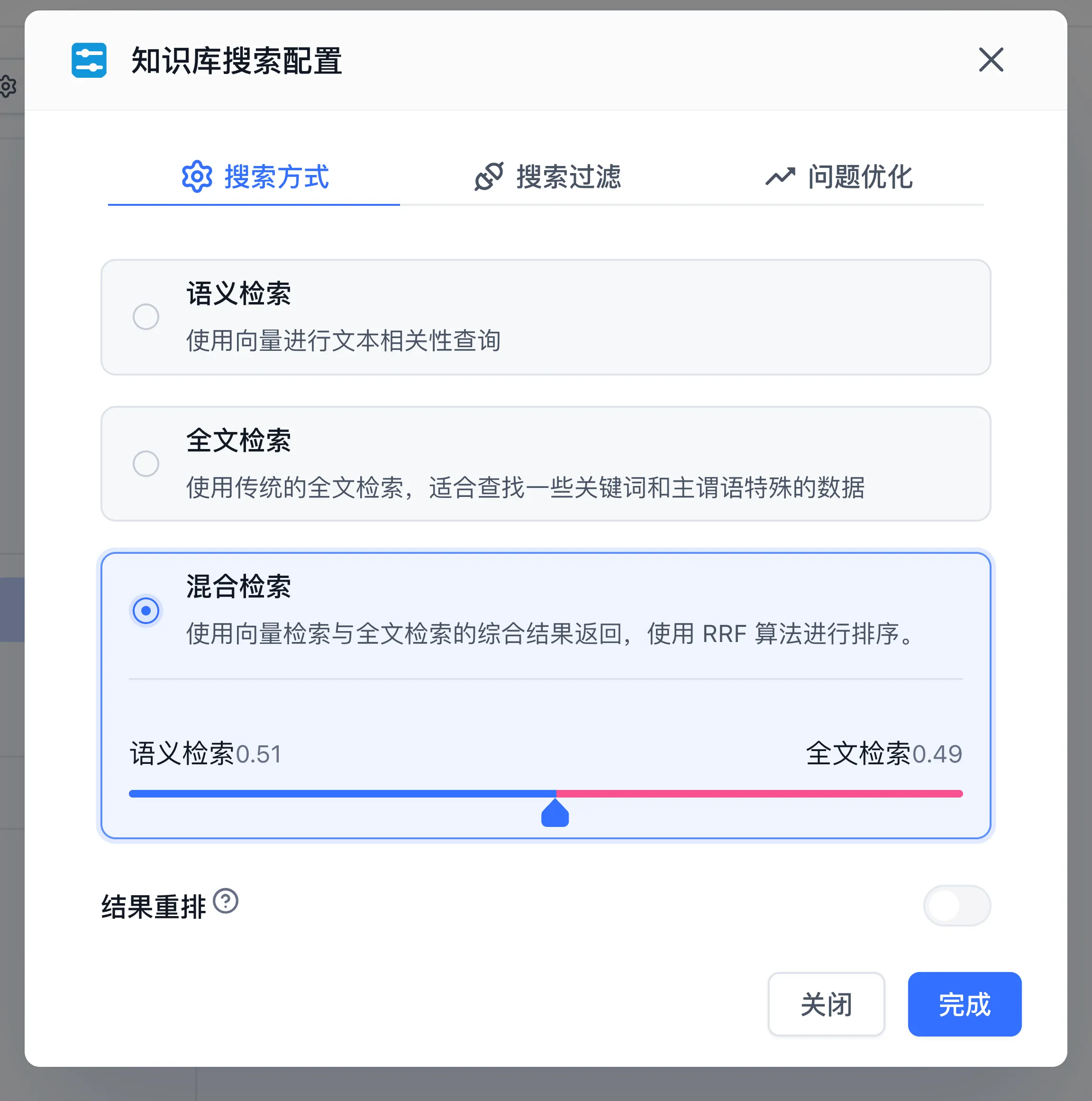
Hybrid Search and Two-Stage Reranking
Text hybrid search follows this pipeline, with reranking controlled by application settings:


- Stage 1: Multi-Route Recall: The engine queries the vector database and full-text index in parallel, then combines candidate chunks using the configured route weights.
- Stage 2: Cross-Encoder Reranking: When enabled, the system passes the query and candidate text to a Rerank model and blends the reranked results. Rerank failures preserve the original recall results. Score semantics depend on the model and provider; calibrate thresholds against labeled examples.
- Threshold Filtering and Selection: The engine performs final deduplication, applies the supported score filter, and selects whole ranked chunks within a token budget. The final chunk can take the accumulated size beyond the budget boundary.

Key Search Parameters
In search testing and application configuration, these parameters govern retrieval quality:
| Parameter | Valid Range | Recommendation and Behavior |
|---|---|---|
| Search Method | Semantic search / Full-text search / Hybrid search | Hybrid search is the recommended default, providing semantic generalization and exact term matching. |
Citation cap (limit) | Token budget | Controls retrieved context size; tune with chunk size and the application context window. |
| Lowest correlation | 0 ~ 1 | Uses rerank scores when reranking succeeds, or embedding scores in pure semantic search mode. Other modes may skip score filtering; inspect usingReRank and usingSimilarityFilter where exposed. |
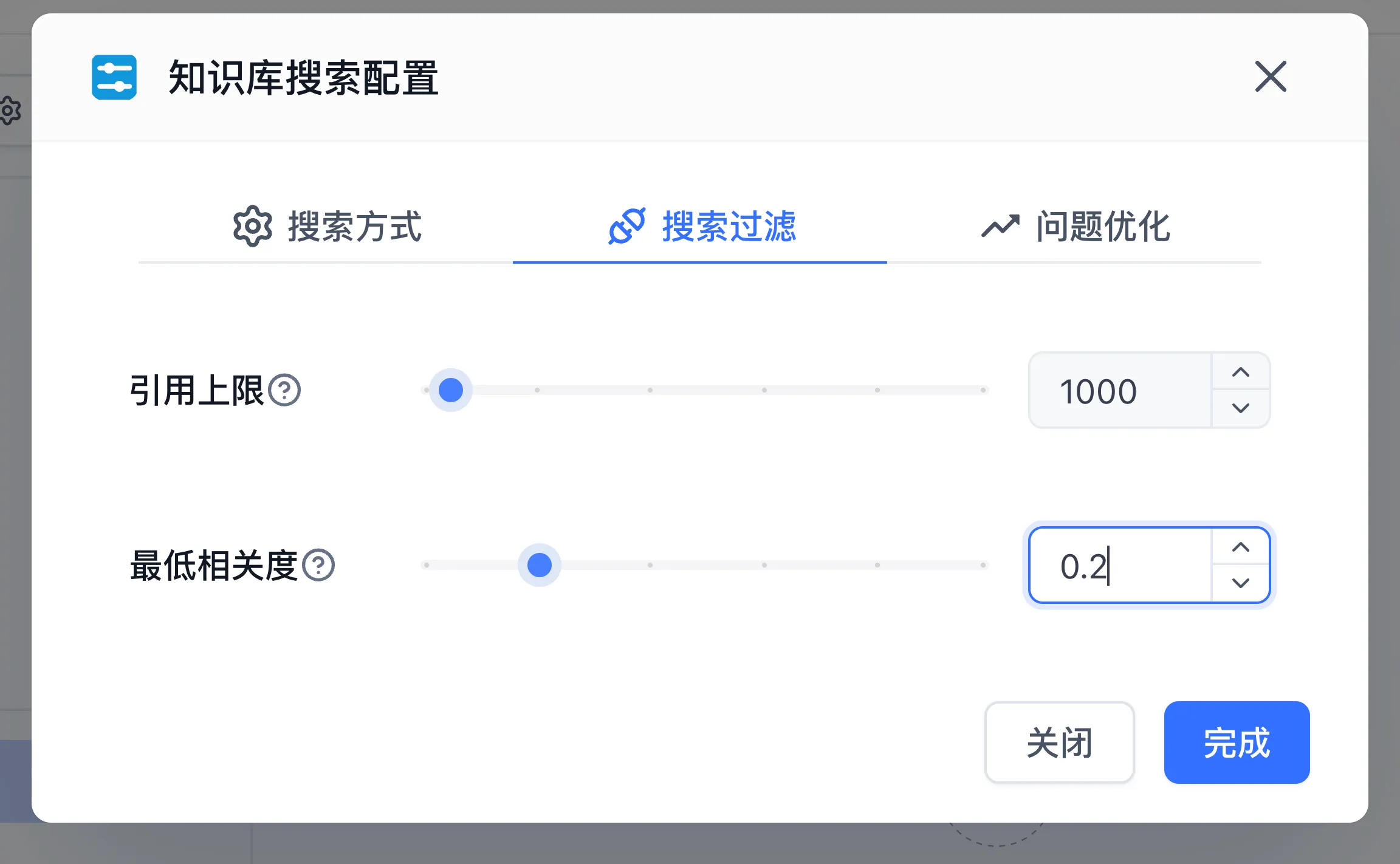
Image Retrieval Architecture
Knowledge base retrieval supports image inputs across two indexing and recall paths depending on the models configured on the knowledge base:
- Image Description Retrieval: With a Vision Language Model (VLM) configured, the system generates text descriptions of images during ingestion and query time, matching them through standard text retrieval.
- Image Vector Retrieval: With a multimodal Embedding model that accepts image inputs, the system encodes images directly into vectors and matches them against stored image embeddings.
| Knowledge Base Model Combination | Text-Only Query | Image-Only Query | Text + Image Hybrid Query |
|---|---|---|---|
| Standard Text Embedding (No Vision Model) | Standard text retrieval | No image retrieval path | Uses text input only |
| Standard Text Embedding + Vision Model | Standard text retrieval (matches ingested image descriptions) | Converts query image to description for text retrieval | Combines query text and image description |
| Multimodal Image Embedding (No Vision Model) | Standard text retrieval | Direct image vector similarity search | Fuses text retrieval and image vector search |
| Multimodal Image Embedding + Vision Model | Text retrieval (matches ingested image descriptions) | Dual-route image description + image vector search | Multi-route RRF fusion across text, image description, and image vector |
Common Retrieval Symptoms and Tuning Matrix
| Symptom | Recommended Checks and Adjustments |
|---|---|
| No relevant chunks returned | Confirm collection indexing is complete; lower Lowest correlation; raise the Citation cap (limit); check whether the query is too short or missing subject context |
| Results are overly broad or off-topic | Raise Lowest correlation; reduce Citation cap to trim noisy chunks; refine chunk splitting size; apply Tag Filters to narrow the collection scope |
| Serial numbers, article codes, or error codes miss | Switch to Hybrid search or Full-text search; increase full-text weight; disable query rewriting on exact code queries to preserve literal terms |
| Conversational or paraphrased queries miss | Enable Hybrid search with a Rerank model; enable query rewriting to resolve multi-turn coreferences; add custom index questions to high-value chunks |
| Noticeable latency after enabling query rewriting | Query rewriting adds an LLM call before retrieval; switch to a lower-latency model or enable it selectively for multi-turn follow-up scenarios |
| Ranking remains inaccurate with Rerank enabled | Verify that the user query forms a complete statement; confirm first-stage recall returns enough candidates; calibrate similarity thresholds against run details |
| Weak image-to-image recall | Confirm the knowledge base uses a multimodal Embedding model or Vision model and that images generated valid image indexes during import |
| Unstable text + image hybrid results | Clarify the primary query signal; upload the image alone when searching purely for visual similarity so extra generic text does not dilute RRF ranking |
Next Steps
- Practice parameter tuning: Follow Search Testing and Retrieval Parameters.
- Attach to applications: Follow Connecting Knowledge Bases to Applications.
- Engineering RAG pipelines: Explore RAG Architecture and Anti-Hallucination.
Last updated